
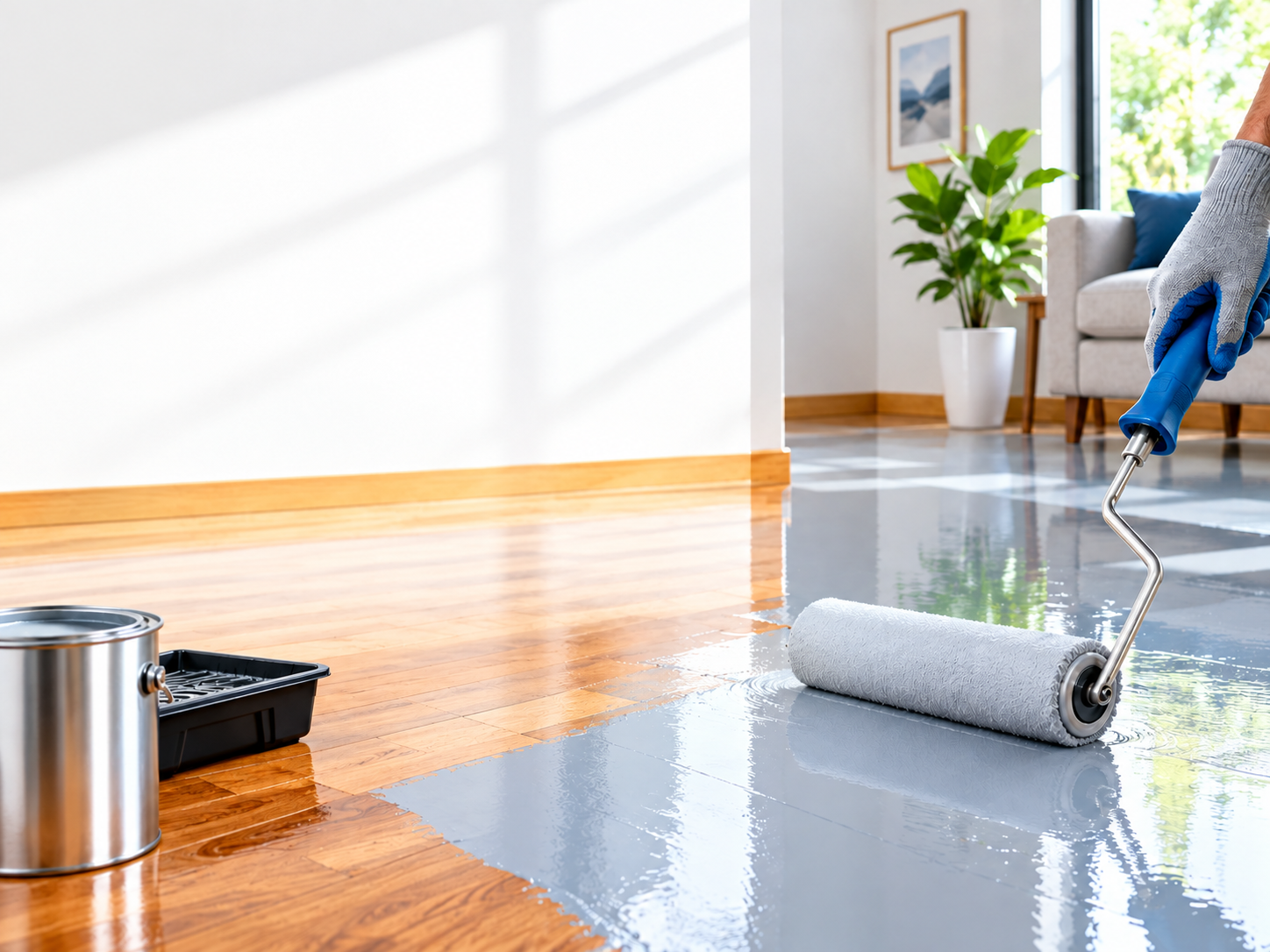

A wooden floor can look perfectly sound on Monday and become a coating problem by the time humidity changes, machinery starts moving, or moisture finds its way underneath.
That is the part many people overlook when considering epoxy floor paint for wood floors. Epoxy creates a hard, durable surface, but wood is not a static substrate. It expands, contracts, and responds to moisture differently from concrete.
But can epoxy be used on wood floors?
Yes. But only when the substrate, preparation method and coating system are suitable for the application. Let’s look at it in detail.
Can Epoxy Be Used on Wood Floors?
Yes, epoxy can be applied to certain wooden substrates, but it requires considerably more attention than a conventional concrete floor epoxy application.
Wood is hygroscopic, meaning it naturally gains and loses moisture from its surroundings. That moisture movement causes dimensional changes in the timber.
Epoxy cures into a hard, resinous layer. If the wood moves significantly while the cured coating remains rigid, stress can develop at the bond line.
It can result in:
- Cracking
- Peeling or delamination
- Blistering
- Loss of adhesion
- Cracks appearing over joints between boards
This is why epoxy over hardwood floors should be treated as a substrate-engineering decision rather than simply a painting job.
Why Is Wood More Difficult Than Concrete for Epoxy Flooring?
Most industrial epoxy flooring systems are designed around a stable, properly prepared substrate. Chanda Paints' existing guide explains why surface preparation, priming, coating, and curing are treated as parts of the overall epoxy flooring system rather than isolated steps.
Wood introduces additional variables.
Wood Moves With Moisture
A wooden floor responds to changes in humidity and moisture. Individual boards can expand and contract, while joints between boards can also move.
A rigid coating placed over a moving substrate has limited ability to accommodate that movement.
Wood Can Hold Moisture
Moisture trapped beneath an impermeable coating can create adhesion problems and blistering. The surface may appear dry while moisture remains within the timber or enters from below.
Before applying an epoxy coating for wooden floors, moisture conditions therefore need to be assessed rather than assumed.
Existing Finishes Can Interfere With Adhesion
Old varnish, wax, polish, paint or other finishes can prevent the epoxy system from bonding properly to the wood.
This is one reason sanding and mechanical preparation are critical.
Joints and Deflection Matter
A wooden floor may have visible joints, gaps or areas that flex under load. If these issues are ignored, the coating can simply reproduce the movement underneath it.
The coating cannot compensate for an unstable floor.
Epoxy Floor Paint vs Epoxy Resin for Wood Flooring
|
Aspect |
Epoxy Floor Paint |
Epoxy Resin for Wood Flooring |
|
Primary purpose |
Designed to protect and finish floor surfaces |
Generally used to create a resinous, sealed or decorative surface over wood |
|
Typical application |
Floors in commercial, industrial and utility environments |
Wooden floors and surfaces where a resin-based finish or encapsulation is required |
|
Formulation |
Formulated as a floor coating system with specific performance properties |
Formulation varies widely depending on whether it is decorative, sealing or flooring-grade resin |
|
Appearance |
Available in different finishes, including smooth and high-gloss options |
Often selected where a clear, decorative or encapsulating finish is desired |
|
Industrial suitability |
Suitable when the selected system is compatible with the substrate and operating conditions |
Not every wood resin is suitable for industrial flooring; the product specification must be checked |
|
Selection priority |
Traffic, substrate condition, moisture, chemical exposure and required performance |
Wood condition, movement, moisture, desired finish, resin formulation and intended use |
How to Apply Epoxy Over Hardwood Floors
Even though the exact application sequence varies according to the product and substrate, a typical project involves several controlled stages.
Surface assessment ➜ preparation ➜ cleaning ➜ primer ➜ epoxy body coat ➜ additional coat/topcoat ➜ curing
The mix ratio, pot life, application temperature, recoat window, film thickness, and curing time should come directly from the technical data sheet of the selected epoxy product.
Remember to treat these parameters as interchangeable between manufacturers.
This is another reason why choosing the right industrial epoxy coating matters. It will not only help you evaluate traffic, surface condition, coating type, and application process ahead, but also ensure long-lasting protection.
What Are the Benefits of Epoxy Coating for Wooden Floors
When the substrate and coating system are properly matched, epoxy can provide several practical advantages.
- A Hard, Seamless Surface
Epoxy can create a continuous surface that is easier to clean than an exposed, heavily jointed or damaged floor.
- Better Resistance to Stains and Spills
A properly cured epoxy surface can offer resistance against many common oils, chemicals and contaminants, depending on the formulation.
This is one of the reasons epoxy systems are widely used in demanding industrial environments.
- Easier Maintenance
A properly finished seamless coating can make routine cleaning easier by reducing areas where dirt and contamination accumulate the most.
- Improved Appearance
For suitable commercial or industrial spaces, epoxy can also create a uniform finish that makes an older floor look significantly cleaner and more controlled.
But appearance should come after substrate suitability. A glossy finish is not a substitute for a stable floor.
When Should You Avoid Epoxy on Wood Floors?
There are instances when another alternative for flooring material or substrate is a better choice.
Do not use epoxy as an easy solution when the wooden floor:
✘ Significant moisture problems
✘ Rot or biological deterioration
✘ Excessive flexing
✘ Unstable or loose boards
✘ Severe structural damage
✘ Persistent movement that cannot be controlled
This is particularly relevant for warehouses and manufacturing facilities where forklift traffic and mechanical abrasion are constant. Chanda Paints' existing article on high-traffic warehouse floor protection with epoxy floor coatings discusses why the flooring system must be designed around operational loads rather than surface appearance alone.
How to Choose the Best Epoxy for Wood Floors
Indian conditions make moisture and temperature control especially relevant during flooring projects.
If you're evaluating wood floor epoxy paint in India, don't start with the cheapest or highest-gloss product. Start with the application.
You must ask your industrial coating provider:
- What will the floor experience?
- What condition is the wood in?
- Is the product actually specified for wood?
- What preparation does the manufacturer require?
- Can the manufacturer provide technical guidance?
The right high gloss epoxy manufacturer should be able to discuss the substrate and operating conditions instead of simply recommending the most expensive coating.
Get the Best Epoxy for Wood Floors Project!
Choosing an industrial coating does not end with finding the strongest solution.
Industrial paints are engineered differently to withstand specific environmental conditions. Likewise, not all epoxy coatings are built for hardwood floors. The right system depends on the substrate, expected traffic, exposure conditions, preparation requirements and the performance you need from the floor.
If you are looking for an epoxy floor paint for wood floors, discuss your substrate and application requirements with Chanda Paints before finalizing the product specification.
Frequently Asked Questions (FAQs)
Can epoxy floor paint be used on wood floors?
Yes, but only under the right epoxy resin system and when the wood surface is well prepared and stable. Regular epoxy meant for concrete should not necessarily be used on wood.
Is epoxy coating suitable for hardwood floors?
This is possible if the wooden material is stable and dry. Too much movement or bending may result in cracks, peeling, and delamination.
What type of epoxy is best for wooden floors?
It is better to have resin flooring that is compatible with wood, as per the traffic load anticipated on it. If there is any need for movement, a system that is flexible or an underlayment might be needed.
How do you prepare a wood floor before applying epoxy paint?
It is necessary that the floor be structurally stable, clean, dry, and not treated with any waxes, varnishes, grease, or any other substance. It will also depend on the system. Sanding and priming may also be needed.
Will epoxy crack on wood floors due to movement?
Yes, it will. This is because wood moves when there is any change in the environment around it, whereas the cured epoxy does not move much.
Can epoxy be applied over old wooden flooring?
Yes, but the floor should first be evaluated for stability, moisture, contamination, and movement. The condition of the floor will determine whether more plywood is needed or another underlayment is recommended prior to installing the resinous flooring system.
How long does epoxy floor paint last on wood floors?
No definite lifespan can be guaranteed by the use of epoxy on wood surfaces. This is because the lifespan is dependent on many factors including surface movement, substrate preparation, moisture content, coating system, usage, and maintenance.
Is epoxy floor paint for wood floors waterproof?
The curing of the epoxy coating produces a watertight surface, but it does not create a fully waterproof surface for the wooden floor. The presence of moisture through joints or under the wooden substrate is likely to cause trouble.
What are the advantages of epoxy coating on wooden floors?
If done correctly, epoxy can create a surface that is smooth and durable, with stain resistance, chemical resistance, and wear resistance. However, the appropriateness of using epoxy depends on the quality and movement of the wooden surface beneath it.
Where can I buy epoxy floor paint for wood floors in India?
In case of industrial projects, it would be more suitable to obtain the coating material from the paint manufacturer, who would advise you regarding the industrial paint or flooring system to be used according to your requirement. You can contact Chanda Paints for this purpose.