
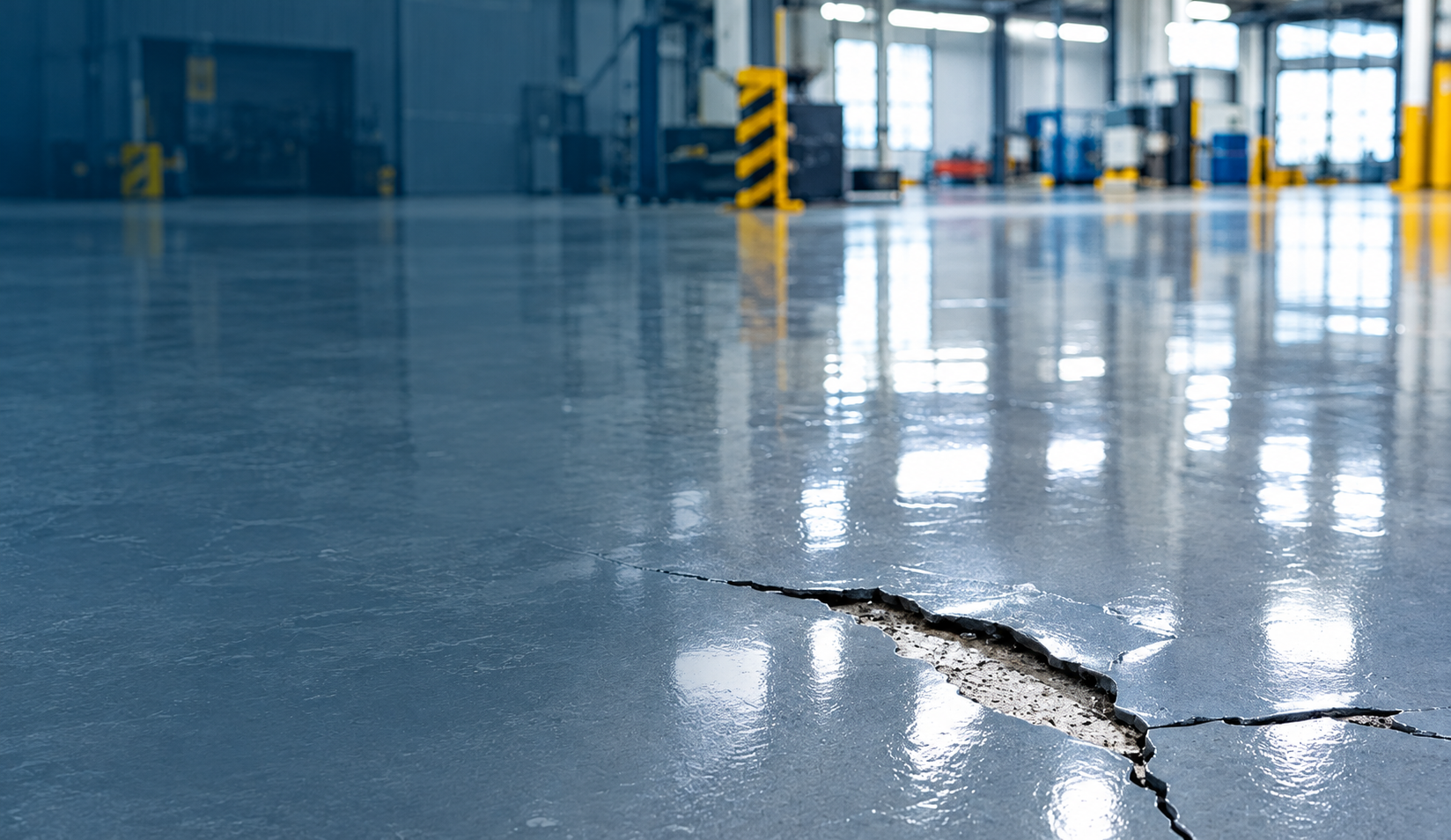
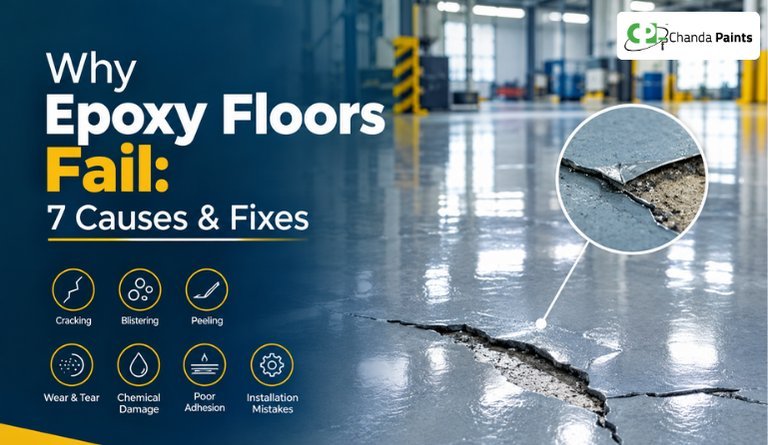
Flooring demand for factories, warehouses, and industrial plants goes beyond appearance. They require strong protective layers to withstand day-to-day heavy loads.
That’s why epoxy flooring has become one of the most popular solutions for industrial owners and engineers. But factory owners and facility managers often come to us with a common issue: epoxy floor failure!
Ahead, we are going to share 7 reasons why epoxy floors fail even with quality materials and how to fix each one.
Let’s dive in!
Why Do Epoxy Floors Fail?
Epoxy floor coating is a protective coating system, not just a coating layer on concrete. Its effectiveness depends on how well the coating adheres to the substrate and how suitable the overall coating is for the environment in which it will be used.
A coating intended for use in a light-duty warehouse may not survive in an environment where forklifts and abrasive or harsh chemicals are constantly being utilized. Conversely, even the most expensive epoxy coating will not perform well if applied to damp or contaminated concrete.
However, it is important to draw the line between product failure and substrate failure. In case of substrate failure, replace the coating without finding out why it failed.
7 Causes of Epoxy Floor Failure
-
Poor Surface Preparation: Common Epoxy Floor Peeling Causes
Some of the main reasons why epoxy flooring comes off are due to poor surface preparation. Just because a concrete slab looks clean, it may not actually be ready to have an epoxy coating placed on it.
Contaminants like dust, oil, grease, curing agents, and many other substances are just some of the things that may interfere with proper adhesion. A smooth and dense concrete surface is another reason it may come off.
How can it be avoided?
Make surface preparation an integral part of the project. The concrete surface must meet the coating system’s requirements and substrate strength before the application begins.
-
Moisture in Concrete Epoxy Flooring: Bubbling & Blistering
A surface may appear dry, but there may still be moisture underneath the concrete. This moisture can affect the application of epoxy coating if it starts rising to the surface.
This is especially the case in an industrial facility at the ground floor level, old buildings, basements, and places where the concrete is exposed to moisture through the ground. That’s why preparing the surface is as important as choosing a specialized epoxy for concrete floors.
Epoxy Floor Bubbling Fix
- Begin by establishing whether or not the presence of moisture has been established.
- Blisters can also be caused by air entrapment or outgassing and, thus, their mere presence does not mean anything.
- Identify the cause of the moisture as well as the condition of the current coating.
- The repair process may require removing affected areas and installing a compatible moisture mitigation system before recoating.
-
Incorrect Mixing Ratio or Poor Mixing Technique
Epoxy coating typically consists of two substances: resin and hardener. These need to be mixed in a specific ratio for the desired curing process.
If installers measure the quantity without referring to the manufacturer’s instructions, it could make the coating soft and not properly cured. Moreover, if there is improper mixing, it could create some regions with different properties although the ratio is right.
Epoxy Coating Adhesion Failure
If the coating remains tacky, soft, or uneven after a specific curing time, investigate the epoxy adhesive condition before attempting a repair. Adding another layer over an uncured coating is not a dependable fix.
-
Incorrect Application Conditions and Premature Floor Use
The application of epoxy does not only depend on the quality of the product used. Temperature, humidity, and even the condition of the base may influence the application and curing process.
The application of the floor finish outside its authorized temperature or humidity conditions may cause poor flow or non-uniform curing. The incorrect thickness of the application may be another source of problems.
-
Choosing the Wrong Epoxy System for Industrial Traffic
Not every epoxy floor is designed for the same workload. A coating that performs well in a storage room may deteriorate quickly in a production facility where forklifts turn repeatedly, heavy equipment moves across the surface and dropped materials cause impact damage.
This is where epoxy floor cracking reasons and premature wear often become linked to specification mistakes. The coating may be expected to withstand loads, impacts, abrasion or chemical exposure beyond its intended capabilities.
-
Epoxy Floor Cracking Reasons
However, in some cases, it is not the epoxy coating that is at fault. The concrete under the epoxy might be cracked, have weak areas, settlement problems, or moving joints due to the effects of temperature and load on the structure.
If the substrate moves, a rigid coating will follow and form a crack in the same place. No amount of correctly applied epoxy will take care of the defects present in the concrete.
This explains why applying epoxy on cracks without understanding the cause will lead to recurring failures.
-
Chemical Exposure, Abrasion and Poor Maintenance
Epoxy floors have been chosen because of their durability and resistance to chemicals. Nevertheless, resistance greatly differs from product to product or from flooring system to flooring system.
If a coating is resistant to one particular chemical, it does not mean that it will be able to resist other chemicals, particularly at higher temperatures or for long periods of time.
Note: Cost of the coating is another factor that influences flooring failure because a coating that looks expensive may come with specialized engineering to deal with specific industrial conditions. Likewise, an affordable solution does not mean cheaper in quality. Want to evaluate the cost of epoxy for industrial flooring? Explore our detailed guide!
Epoxy Flooring Problems and Solutions: Quick Fixes
|
Visible Problem |
Possible Cause |
Recommended First Step |
|
Peeling or flaking |
Poor preparation, contamination or adhesion failure |
Inspect the concrete and test the bond |
|
Bubbles or blisters |
Moisture, trapped air or outgassing |
Investigate moisture and application conditions |
|
Soft or sticky patches |
Mixing errors, unsuitable conditions or incomplete curing |
Check batch records and curing requirements |
|
Cracks in the coating |
Concrete movement, impact or unsuitable system |
Inspect the substrate and crack behaviour |
|
Scratches and surface wear |
Abrasion, traffic or inadequate coating specification |
Assess wear depth and operating conditions |
|
Chemical damage |
Incompatible coating or prolonged exposure |
Identify the chemical and verify compatibility |
|
Repeated failure after repair |
Original cause not corrected or incompatible repair materials |
Reassess the full flooring system |
How to Prevent Epoxy Floor Failure in Industrial Facilities
Preventing epoxy flooring problems starts well before the first coat is applied. Here is a practical preventive plan you should follow:
- Assess the Concrete: Check concrete strength, contamination, cracks and moisture conditions before installation.
- Prepare the Surface Correctly: Use the preparation method required by the specified flooring system.
- Select the Right Coating: Match the system to the expected traffic, abrasion, chemical exposure and operating environment.
- Control Application: Follow the prescribed mixing ratios, coverage, temperature limits and application procedures.
- Allow Adequate Curing: Keep the area closed to traffic until the coating has reached the required service condition.
- Plan for Maintenance: Use compatible cleaning products, remove spills promptly and inspect high-wear areas regularly.
Conclusion
When an industrial floor fails, the replacement decision should start with the conditions on site rather than the product quality alone.
Different industrial facilities require different mechanical strength, chemical resistance, abrasion resistance, cleanability and downtime. The answer to why epoxy floors fail requires understanding the underlying causes. Hope the above causes help you identify what causes your facility’s floor failure.
Now is the time to let the professionals handle the repair. Chanda Paints can be your starting point for exploring industrial coating solutions suited to your project requirements. Let’s discuss your site’s operational condition before finalizing a coating specification.
Frequently Asked Questions (FAQs)
Why is my epoxy floor peeling?
Causes of peeling epoxy floor coating include improper concrete substrate preparation, contaminated substrate, moisture issues, and insufficient adhesion. Establish the cause of the problem and remove any loose coating prior to repair.
What causes bubbles in epoxy flooring?
Bubbles may occur due to moisture vapors, air release through pores in concrete, or incorrect mixing or application process. The proper remedy depends upon the specific problem.
Why is my epoxy floor cracking?
Cracking can happen because of cracks in the concrete, movements in the concrete, impact damage, a weak substrate, or an inappropriate coating system. Examine the concrete before coating repair.
Can moisture in concrete damage epoxy flooring?
Yes. Moisture or moisture vapor that goes through concrete can create blisters, peel off, and lose its adhesion. Make sure you test your substrate first before installing epoxy.
How do I fix a bubbling epoxy floor?
Determine if it is moisture, entrapped air, or improper application that created the bubbles. Strip off the coating wherever required and rectify the problem. Prepare the surface and apply an appropriate repair system.
How do I prevent epoxy floor failure?
It is important to consider the preparation of the concrete, test for moisture, mixing, application, and proper curing time. Also, a coating system appropriate for that particular building should be selected.
Can epoxy be applied over a cracked concrete floor?
Yes, provided the cracks are evaluated and corrected in the right way before coating. Movement cracks or joints may need special consideration since an epoxy coating, which is hard, could crack again if there is any movement.
Why is my epoxy floor turning yellow or chalky?
Yellowing may be caused by the effect of UV rays, especially with an epoxy paint system where there is inadequate protection against UV rays. Weathering or surface deterioration will lead to chalky paint.
How long does a properly installed epoxy floor last?
The coating system lifespan depends on coating thickness, product quality, substrate condition, vehicle movement, chemical spills, and maintenance. The lifespan depends on the system and the operational conditions.
When should an epoxy floor be repaired instead of recoated?
Where there is localized damage, just the affected area needs to be patched up since the other areas of the coating will still be strongly adhering to the surface. It might be more appropriate to recoat a good floor that has only worn out on the surface.