
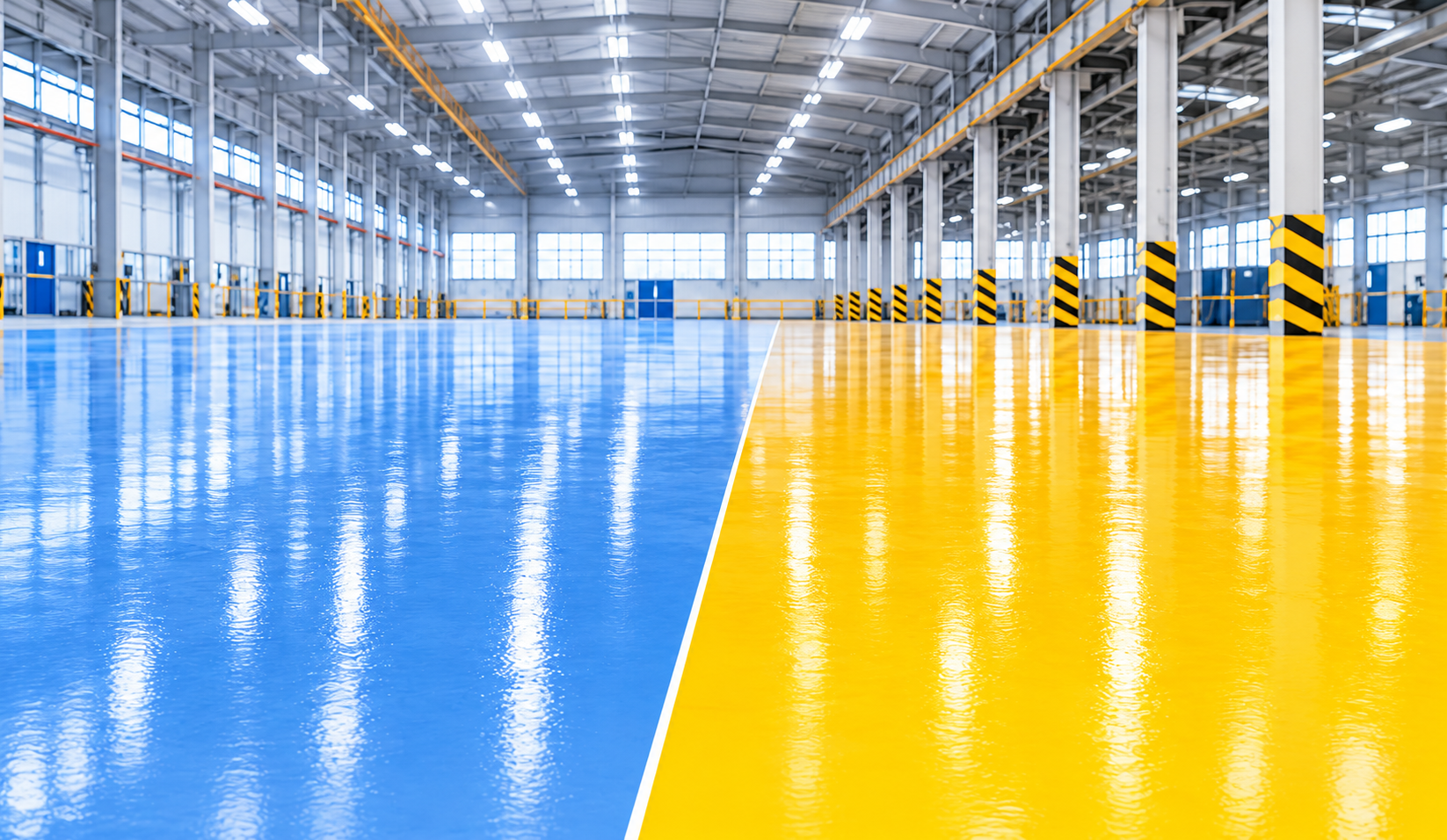
Many people think epoxy and polyurethane are interchangeable. Although both are hardening resin systems, they’re different types of protective coatings with different chemical compositions, suited to different industrial settings.
While epoxy coatings are known for their hardness and chemical resistance, polyurethane coatings offer flexibility, abrasion resistance and better performance under certain environmental conditions. Choosing the wrong protective coating can lead to cracks, surface damage, dust and deterioration.
So, when comparing epoxy vs polyurethane coatings, which one should industrial owners actually choose? Let’s find out!
Understanding Epoxy and Polyurethane Floor Coatings
Before comparing both floor coatings’ performance, let’s understand how these two coating systems work.
Epoxy Floor Coating: Epoxy floor coating is a two-component protective system, mixing resin with a suitable hardener. Once mixed and cured, it forms a hard, seamless surface that bonds strongly with the base.
We also have a detailed guide on epoxy floor coating.
Polyurethane Floor Coating: Polyurethane (PU) floor coating is a resin-based protective system known for its flexibility, abrasion resistance and weathering performance. Unlike conventional rigid epoxy coatings, many polyurethane formulations can accommodate minor substrate movement and better withstand certain types of impact and temperature fluctuations.
Epoxy vs Polyurethane Floor Coating: Industrial Floor Coating Comparison
As you have understood, both protective coatings provide effective protection, but their performance characteristics differ. Here’s a side-by-side comparison:
|
Factors |
Epoxy Floor Coating |
Polyurethane Floor Coating |
|
Surface hardness |
Generally harder and more rigid |
Tough with greater flexibility |
|
Chemical resistance |
Excellent against many chemicals, depending on formulation |
Good to excellent, depending on formulation |
|
Abrasion resistance |
Very good |
Very good to excellent |
|
Impact resistance |
Can be vulnerable to cracking under severe impact |
Better impact absorption in many systems |
|
Flexibility |
Relatively rigid |
Generally more flexible |
|
UV resistance |
Conventional epoxy may yellow or chalk |
Aliphatic PU offers better UV stability |
|
Appearance |
Available in smooth, glossy and coloured finishes |
Available in different finishes with good colour retention |
|
Typical applications |
Factories, warehouses and workshops |
Exposed areas, selected production floors and protective topcoats |
What Are the Epoxy Floor Coating Benefits
Epoxy floor coatings offer several advantages and are one of the most popular choices for industrial and commercial flooring applications.
- High Mechanical Strength: Creates a hard, durable surface capable of handling heavy machinery, equipment and regular industrial traffic.
- Excellent Chemical Resistance: Protects concrete floors against many industrial chemicals, oils, grease, acids and alkalis, depending on the formulation.
- Superior Surface Protection: Forms a protective layer that helps prevent concrete deterioration, surface damage and dust formation.
- Strong Adhesion: Bonds effectively with properly prepared concrete substrates, providing a reliable flooring system.
- Low Maintenance Requirements: Its smooth, non-porous finish makes routine cleaning easier and reduces the accumulation of dirt and contaminants.
- Customisable Finishes: Available in different colours, textures and finishes to meet specific industrial flooring requirements.
What Are the Polyurethane Floor Coating Benefits
PU floor coatings provide several performance advantages for industrial environments exposed to heavy traffic, impact and changing environmental conditions.
- Excellent Abrasion Resistance: Withstands regular wear caused by forklifts, machinery, material handling equipment and foot traffic.
- Greater Flexibility: Offers better flexibility than conventional epoxy coatings, helping accommodate minor substrate movement and reducing the risk of certain types of cracking.
- UV Resistance: Aliphatic polyurethane coatings provide better resistance to UV exposure, helping minimise yellowing, chalking and colour deterioration.
- Chemical Resistance: Protects floors against various oils, solvents, cleaning agents and industrial chemicals, depending on the formulation.
- Colour and Gloss Retention: Helps maintain the floor's appearance over time, particularly in areas exposed to sunlight when suitable PU formulations are used.
- Moisture and Stain Resistance: Provides a protective surface that helps limit liquid penetration and staining when correctly specified and applied.
Epoxy Floor Coating vs Polyurethane: Which Industries Need Which?
The most suitable coating for industrial floors depends on the actual operating environment rather than industry type. Here are some practical examples:
Manufacturing Plants
Manufacturing facilities require flooring that can withstand machinery, heavy material movement, oil spills and regular cleaning. Epoxy coating is a suitable choice for indoor production areas for its quick cure, adhesion, and chemical resistance. However, areas that face temperature fluctuations require heat-resistant coatings like polyurethane systems.
Warehouses and Distribution Centres
Warehouses experience continuous movement of forklifts, pallet trucks and stored materials. High-build epoxy systems can provide a durable, seamless surface for dry indoor storage and distribution areas.
Food and Beverage Processing Units
Food processing units have demanding hygiene and cleaning requirements. Frequent washdowns, cleaning chemicals and temperature changes can put considerable stress on flooring. Specialised polyurethane-cement systems are often worth considering for wet processing areas, particularly where thermal shock resistance is required.
Chemical and Pharmaceutical Facilities
Chemical exposure, contamination control and ease of cleaning are major considerations in these environments. Specially formulated epoxy systems can provide excellent protection. Polyurethane coatings may also provide protection where UV resistance is required.
Can Epoxy and Polyurethane Coatings Be Used Together?
Choosing between epoxy and polyurethane coatings does not always mean selecting only one coating. In fact, combining both can be a more practical solution for certain facilities.
A common industrial flooring arrangement uses an epoxy primer and body coat to establish adhesion, build thickness and provide mechanical and chemical protection.
A compatible polyurethane topcoat is then applied to improve surface wear characteristics, flexibility and, in the case of suitable aliphatic systems, UV resistance.
This approach allows each material to contribute its strongest properties.
However, compatibility between layers, surface preparation, recoat windows and curing conditions must be checked before application. Not every epoxy and polyurethane product is designed to work together.
Get the Best Coating for Industrial Floors
An industrial floor coating is a long-term investment in the protection, maintenance and functionality of your facility. Choosing the right formulation and application system from the beginning can help prevent premature surface deterioration and unnecessary maintenance interruptions.
At Chanda Paints, industrial coating solutions are developed around the performance requirements of demanding industrial environments. Whether you are evaluating epoxy floor coatings or exploring polyurethane-based protection, consult a coating expert to determine the right system for your facility.
Connect with Chanda Paints to discuss your industrial floor coating requirements.
Frequently Asked Questions (FAQs)
What is the difference between epoxy and polyurethane coating?
Epoxy coatings create a hard, rigid surface with excellent adhesion and chemical resistance. Polyurethane coatings offer greater flexibility, abrasion resistance and better UV stability, depending on the formulation.
Which is better for industrial floors: epoxy or polyurethane?
Epoxy is generally suitable for indoor industrial floors requiring mechanical strength and chemical resistance. Polyurethane is preferable where flexibility, impact resistance, UV exposure or temperature fluctuations are major concerns.
Is polyurethane coating more durable than epoxy?
Not really. Both materials are highly durable under suitable conditions. Polyurethane is superior in some cases of abrasion, impact, and weather exposure, whereas epoxy is hard and resistant to chemicals.
Can polyurethane be applied over epoxy flooring?
Yes. The right kind of polyurethane topcoat can be placed on an epoxy-coated surface. The epoxy provides strength and adhesion, while the polyurethane provides UV resistance and protection of the surface.
Which coating is better for heavy machinery and forklift traffic?
Both can handle industrial traffic when correctly specified. Epoxy offers high compressive strength, while polyurethane can provide better resistance to repeated abrasion, impact and forklift wheel movement in demanding applications.
Which coating is more resistant to chemicals?
Epoxy generally offers excellent resistance to many industrial chemicals, oils, acids and alkalis. However, the actual resistance depends on the chemical type, concentration, exposure duration and coating formulation.
Is polyurethane better for outdoor or UV-exposed areas?
Yes. Aliphatic polyurethane coatings offer better UV resistance and colour retention than conventional epoxy coatings, making them more suitable for outdoor and sunlight-exposed industrial surfaces.
Which coating is better for thermal shock and temperature changes?
Specialised polyurethane systems, particularly polyurethane-cement flooring, generally perform better under thermal shock, hot-water cleaning and sudden temperature changes than conventional epoxy systems.
How long do epoxy and polyurethane floor coatings last?
Both can provide long-term floor protection when properly selected, applied and maintained. Their actual service life depends on coating thickness, substrate preparation, traffic intensity, chemical exposure and maintenance practices.
How do I choose the right industrial floor coating for my facility?
Evaluate your facility’s traffic load, chemical exposure, temperature variations, UV exposure, cleaning requirements and concrete condition. Consult a coating specialist to select a system that meets your operational and durability requirements.