
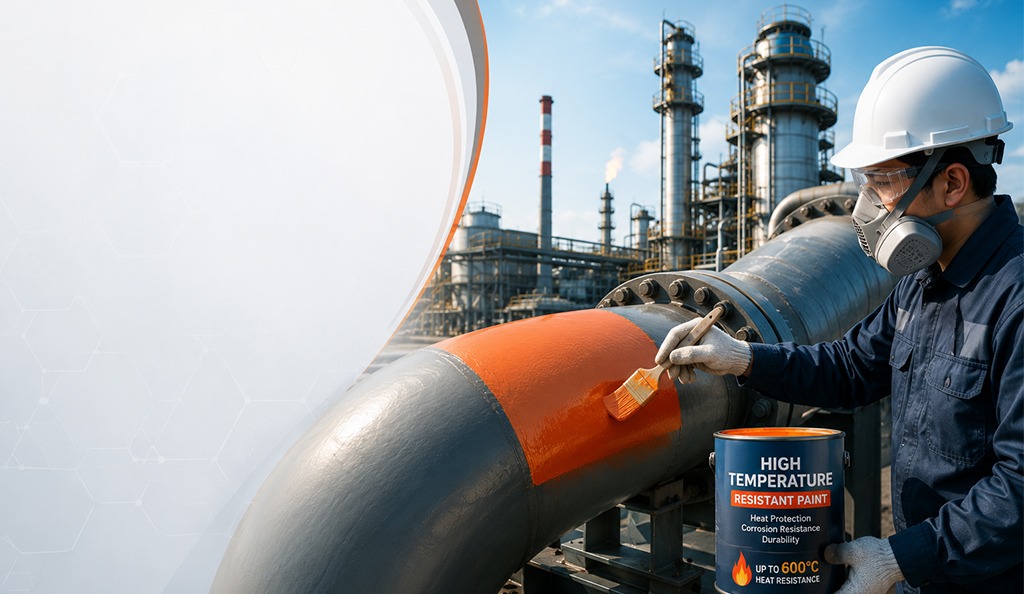
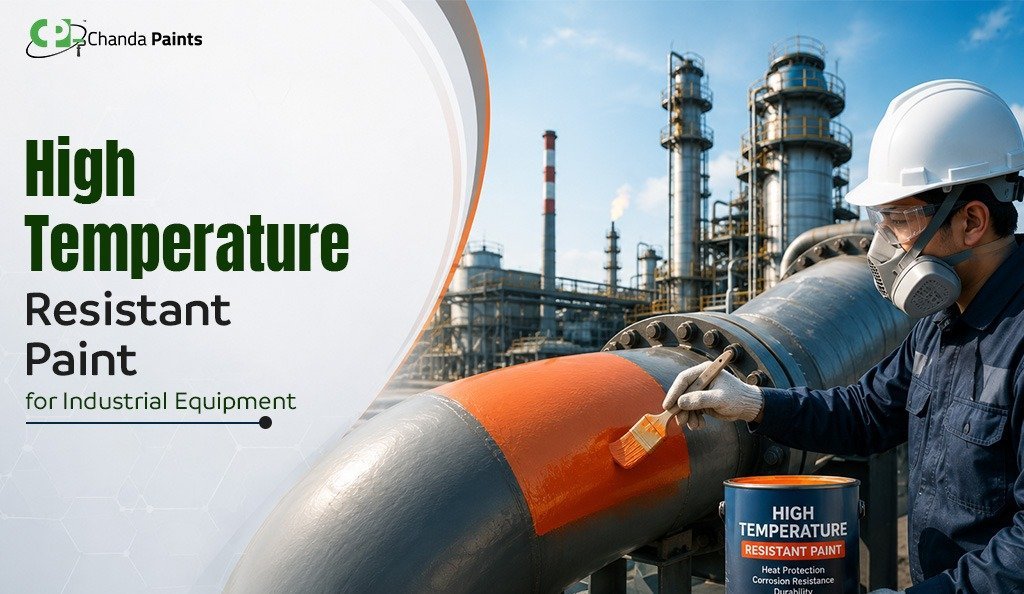
Most of the time, industries consider paints as a protective coating against moisture and corrosion. But industries that deal with high temperatures need paints that are heat-resistant as well.
High temperature industrial paint simply has a different equation. They are less for decorative purposes and more for survival conditions.
So, this guide is for industries that deal with continuous heat exposure, thermal cycling, moisture, chemicals, and operational stress. Where downtime directly impacts production and revenue.
Let’s choose the right high heat resistant paint!
What Is High Temperature Industrial Paint?
High temperature industrial paint is a specific kind of paint created to provide adhesion, color retention, corrosion protection, and structural protection at high temperatures.
Unlike ordinary paints that are known to become soft or peel off in response to heat, these paints are specifically designed to withstand high temperatures without compromising the structure of industrial machinery.
The high-heat resistant industrial paints are generally applied on:
- Boilers and furnaces
- Industrial chimneys
- Heat exchangers
- Exhaust systems
- Processing tanks
- Pipelines
- Metal fabrication equipment
- Manufacturing machinery
Smart industries now treat heat resistant industrial paint as part of preventive maintenance rather than as an expensive finishing.
Why Industrial Equipment Fails Faster Without Heat Resistant Coating
As the surface of the metal expands and contracts due to changes in temperature, the paint film begins breaking down. And as soon as the coating fails, the substrate is exposed to moisture and impurities.
This leads to surface oxidation, accelerated corrosion, reduced thermal efficiency, frequent shutdowns for maintenance, and higher replacement costs.
Carefully selected industrial heat resistant coating acts as a thermal barrier. It helps maintain long-term equipment reliability.
How High Heat Resistant Paint Actually Works
The performance of high heat resistant paint comes from its chemistry.
Most industry-grade heat resistant paints combine advanced binders with stable pigments and additives that maintain film integrity under stressful environments.
Thermal Stability
The coating is highly stable even in high-heat conditions.
Oxidation Resistance
The coating protects against oxidation by restricting oxygen access to metals.
Surface Flexibility
Coatings allow expansion and contraction without breaking the surface.
Corrosion Prevention
Modern Industrial Protective Coatings incorporate both heat stability and environmental resistance.
How to Choose the Right High Temperature Coating for Metal Equipments
In order to choose the proper coating for high temperatures, you should take into account that the material is able to withstand temperatures such as those of your equipment. You should also pay attention to other factors, like environment, substrate, and curing procedure.
Follow these steps to choose the right high temperature costing for metal equipment:
1. Operating Temperature
Identify the maximum temperature that your metal equipment has to deal with. Standard epoxy coatings work well up to 200°C. Inorganic materials such as silicone or ceramic-based formulations are great if the temperature goes up to 650°C.
2. Environmental & Operational Factors
If the metal equipment is exposed to moisture, chemicals, and salts, look for zinc-rich primers as they are especially designed for extreme thermal cycling. But for moving parts or surfaces that face mechanical friction, PTFE (Teflon) based dry-film lubricants act as excellent heat resistance along with low friction.
3. Industry Standards & Compliance
Lastly, understand the specific industrial standards and compliance to evaluate the coating’s chemical composition. The best solution is to consult with the manufacturer and get personalized heat-resistant paint tailored to your industrial conditions.
Best Way to Apply Heat Resistant Industrial Paint to Prevent Failure
Whether your coating will fail or last longer can be decided before it is even applied.
How?
In many industrial projects, heat resistant coating failure is not caused by poor coating quality. It is caused by poor surface preparation. Even the best high temperature industrial paint will underperform if it is applied over oil, rust, or improperly prepared metal.
Here are the appropriate steps to follow for heat resistant paint application:
➤ Cleaning & degreasing the surface & applying heat-resistant primer.
➤ Use an airless sprayer to apply an even layer of paint. (Avoid thick layers)
➤ Follow the heat-curing cycle to cross-link the silicon resin and maximize thermal resistance fully.
➤ Check specific product data sheets to determine your exact cure curve.
Where Heat Resistant Industrial Paint Delivers the Highest ROI
Now let’s talk about the reality… the ROI.
Experienced industrial coating manufacturing teams calculate the cost per maintenance cycle.
A premium costing may initially cost more, but the reduced repainting frequency, labor costs, shutdown hours, and equipment replacement costs explain why it offers better ROI.
You can see strong returns, especially if you operate in:
- Manufacturing plants
- Steel processing units
- Chemical facilities
- Cement plants
- Food processing operations
- Power generation sectors
- Industrial fabrication workshops
Final Thoughts
Industrial machinery is designed to work in a stressful environment. So, the coating that protects it must be able to endure such pressure as well.
The selection of heat resistant industrial paint is not something related to aesthetics but rather the longevity of assets, reduction in downtime, and efficient operation.
If your industrial machinery is constantly exposed to high temperatures, then now would be the right time to find out whether you have a heat-resistant coating system or not. Connect with Chanda Paints today and get your heat resistant industrial paint customized based on your requirements.
FAQs
What is high temperature industrial paint?
Industrial high temperature paint is a special type of paint that is used for the protection of industrial equipment and surfaces that face extreme heat conditions. This type of paint maintains the integrity of the surface while offering resistance to heat and oxidation.
What temperature can high temperature industrial paint withstand?
The temperature rating varies according to the type of paint used. Most industrial high-temperature paints are formulated to be capable of enduring heat between 200 degrees centigrade up to well above 1000 degrees centigrade.
Where is high temperature industrial paint commonly used?
The high temperature industrial paint is widely applied to boilers, furnaces, exhaust ducts, chimneys, pipelines, heat exchangers, machines, storage tanks, and metal processing equipment where heat exposure is continuous.
What is the difference between heat resistant paint and regular industrial paint?
High temperature paint is designed to withstand high temperatures without breaking up, flaking off, or deteriorating. Standard industrial paint can be effective in giving some protection, but not in situations involving prolonged heat exposure.
Can high temperature industrial paint be applied to metal surfaces?
Yes. High temperature industrial paint is commonly applied to metallic surfaces like carbon steel, stainless steel, and fabricated metal structures. It requires adequate surface preparation for successful application.
How long does high temperature industrial paint last?
The life span of the paint coating is based on the temperature at which it is used, environmental factors, quality of the coating, method of application, and maintenance. However, properly applied, good quality paint can easily last 5 to 7 years.
How do I choose the right high temperature industrial paint for my application?
Consider factors like operating temperature, substrate type, environmental exposure, chemical exposure, corrosion needs, and method of application. Considering temperature rating alone for selecting coatings could result in premature failure of the coating.
Is high temperature industrial paint resistant to corrosion and chemicals?
Many types offer not only high thermal stability but also resistance to corrosion, moisture, oxidation, and certain chemicals. The performance depends on the particular coating system used.
What surface preparation is required before applying high temperature industrial paint?
The surface must be free from grease and rust, with a dry, flake-free surface. Techniques like sandblasting and mechanical cleaning are normally suggested to enhance adhesion.
Which industries benefit the most from high temperature industrial paint?
High temperature protective coatings play an important role in industries like manufacturing, steel making, cementing, chemical processing, power production, oil and gas operations, fabrication, and heavy engineering.