
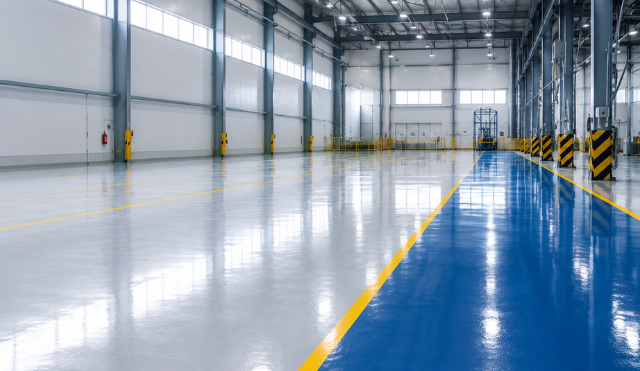
A concrete floor can look perfectly fine when a facility is newly built. But give it a few months & the inner capability will start showing.
Poorly protected concrete floors can become a maintenance headache. Cracks start becoming more noticeable, dust settles everywhere, and stains become difficult to remove. But apply epoxy paint to concrete floors & you can see the difference within a year.
How?
Let’s find out why epoxy paints for concrete floors are the right choice for industries facing heavy traffic, chemical exposure, moisture, temperature extremes, and harsh surface conditions.
Why Do Industries Choose Epoxy Paints for Concrete Floors?
Unlike regular floor paint, epoxy paints are usually chosen for their durability, resistance to chemicals, adhesive nature, and maintainability.
In the case of warehouses, factories, workshops, laboratories, garages, and businesses in general, epoxy coating for concrete floors will change an irregular floor into a smooth one. Here’s why industry leaders rely on epoxy-protected concrete floors for their commercial space:
1. Better Resistance to Heavy Traffic
- Correctly prepared epoxy coating can provide a hard, durable surface that is better suited for harsh industrial conditions.
- Epoxy provides a thick & steady layer that makes the concrete floor a heavy-duty industrial surface.
2. Protection Against Oil, Grease & Chemicals
- Concrete without protection is porous and can absorb oils, grease, and certain chemicals, making it difficult to maintain.
- An epoxy coating for concrete floors creates a more resistant surface, helping facilities manage common industrial spills and contaminants more effectively.
3. Easier Cleaning and Maintenance
- An epoxy surface provides a smooth & glossy finish, which leaves fewer places for dust, dirt, and contaminants to accumulate.
- Industrial epoxy floor coating is particularly useful for manufacturing facilities, workshops, warehouses & commercial spaces where regular cleaning is a part of daily operation.
4. Reduced Concrete Dusting
- Bare concrete or low-quality protection starts generating dust, particularly when it faces high surface pressure.
- A suitable epoxy system seals the concrete surface and helps reduce dust generation from the exposed substrate.
Where Is Epoxy Floor Paint for Concrete Used?
The correct coating largely depends on the operating environment. A coating suitable for use in a low-volume commercial facility may not be ideal for a high-traffic manufacturing plant.
✔ Manufacturing Facilities: Industrial epoxy floor coating provides durable protection to manufacturing units where the floor is exposed to heavy machinery movements, oils, chemicals & continuous traffic.
✔ Warehouses and Distribution Centres: Epoxy coatings can help create a more durable and easier-to-maintain surface for warehouses and distribution centers, particularly in aisles and high-traffic areas.
✔ Automobile Workshops and Garages: Epoxy flooring offers a smoother and easier-to-clean surface, which is critical for automobile workshops & garages.
✔ Pharmaceutical and Healthcare Facilities: The smooth surface of epoxy systems makes it easy to maintain hygiene & housekeeping.
✔ Food Processing Areas: Epoxy coating for food processing ensures an easy cleaning regime and hygienic operating conditions.
What Is Epoxy Paint for Concrete Floor Price
The price for epoxy paint for concrete floors is not universal. It significantly depends on several factors that influence the overall project cost:
➜ Concrete surface condition and preparation requirements
➜ Floor area and project size
➜ Epoxy system and resin formulation
➜ Required coating thickness
➜ Chemical and abrasion resistance requirements
➜ Anti-slip requirements
➜ Site accessibility and project location
For industrial projects, it makes more sense to compare complete flooring systems rather than comparing the per-kilogram price of epoxy products.
If you need an idea of the best possible industrial epoxy flooring cost in India, we have a detailed guide on that.
How to Choose the Best Epoxy Paint for Concrete Floors
The best epoxy paint for concrete floors is the one that matches the actual conditions of the site. Before selecting a product, consider:
Start with Concrete Inspection
Is the concrete new or old? You should answer this question before selecting the coating system.
Understand the Traffic
An office corridor that receives only light traffic and a warehouse that receives lots of forklift traffic would have very different demands on the floor surface. Traffic intensity and load should factor into the choice of floor coating.
Check Chemical Exposure
In case the floor comes into contact with solvents, acids, alkalies, oils, or any other cleaning agents, do not rely on the fact that epoxy can resist all those elements. The chemical resistance specifications of the material must be compared with those actually existing in the environment.
Don't Ignore Moisture
One of the least exciting aspects of flooring is moisture. Where moisture exists in the slab, consideration of the correct moisture evaluation and management system needs to occur before coating.
Final Takeaways
Epoxy paints for concrete floors offer a strong combination of durability, chemical resistance, easier maintenance and a clear finish. But the smartest purchase is not necessarily the cheapest epoxy or even the most expensive one.
It's the system that has been engineered to match your specific industrial or commercial flooring project. Only a correctly specified epoxy system can deliver considerably better long-term value.
Talk to an expert at Chanda Paints and customize your epoxy system based on your needs.
Frequently Asked Questions (FAQs)
What are epoxy paints for concrete floors?
Epoxy paint is a type of paint made from resins and is applied to floors as a protective coat. It is used on surfaces that are to resist damage from traffic, staining, chemicals, and normal wear and tear.
Is epoxy paint good for concrete floors?
Indeed. Epoxy can work perfectly on concrete floors since it will adhere very well and will not wear out easily due to chemicals and other substances. However, one thing to note is that the concrete needs to be in good condition first.
What are the benefits of using epoxy paint on concrete floors?
Epoxy could help to increase the durability, stain resistance and ease of cleaning of concrete floors. It could also provide chemical resistance and increased slip resistance, depending on the composition.
How long does epoxy paint last on concrete floors?
There is no definite lifespan, as this depends on factors such as traffic, film thickness, surface preparation, chemical exposure, and maintenance. An epoxy floor system can offer excellent service in difficult conditions if properly designed and installed.
How do you apply epoxy paint to a concrete floor?
The usual procedure includes cleaning the concrete and making necessary repairs by cleaning it from contaminations and achieving the desired surface profile through grinding or blasting. After that, the ingredients for the epoxy system are mixed together and applied according to the prescribed number of coats.
Does epoxy paint make concrete floors waterproof?
An epoxy coating that is correctly applied will be very resistant to water or even waterproof, but it cannot resolve any moisture issues in the concrete slab. Moisture vapor emanating from the slab may cause blisters, which means that proper moisture testing and preparation are mandatory.
Can epoxy paint be used on old concrete floors?
Yes, epoxy can be applied to existing concrete provided that the surface is in good condition and it has been properly cleaned before application.
How much does epoxy paint for concrete floors cost?
Epoxy paints for concrete floor cost is subject to change due to various factors such as type of paint, condition of the floor, surface preparation, coat thickness, number of coats, among others. When looking at industrial flooring, it would be more realistic to look at the whole flooring system cost than just the material.
What is the difference between epoxy paint and epoxy floor coating?
While epoxy paint normally denotes a coating that is relatively thinner in consistency, epoxy floor coatings can form part of a broader system, which may involve more layers in the coating process. The industrial epoxy systems consist of primers, build coats, aggregates, and even topcoats.
How do I choose the best epoxy paint for concrete floors?
Select not only based on traffic, load, chemical resistance, moisture, thickness, slip resistance and end-use requirements, but also cost. The complete system as well as the surface preparation may sometimes be more critical than the epoxy resin itself in an industrial setting